 By
By It’s a random weekend when the biggest basketball tournament of the year is taking place in your neighbourhood stadium. All of your friends made plans to go and watch it. You guys arrive, everything goes well, and suddenly a whistle cuts through the noise, and the referee throws an arm into a shape you can’t read. Sounds familiar? If so, knowing basketball referee signals is a must. So the next time you go to watch a match, you don’t get confused about what is actually happening on the field.
In this blog, we will guide you through basic basketball official hand signals, why they matter, and more.
Why Basketball Referee Signals Matter
A gym can get painfully loud. Players, coaches, scorers and thousands of fans all need the same information, and shouting won’t reach them. Clear hand movements do. Without basketball referee signals, every call would turn into an argument, and the table crew would be guessing what to record.
Signals also keep things fair. When an official shows the foul type, the player’s number and the number of free throws, nobody is left wondering. It protects the players and the referee, and it keeps the game moving. Leagues even publish standard charts, like the official NFHS basketball signal chart, so officials everywhere use the same gestures.
Violation Signals: When Nobody Fouled, But Rules Get Broken
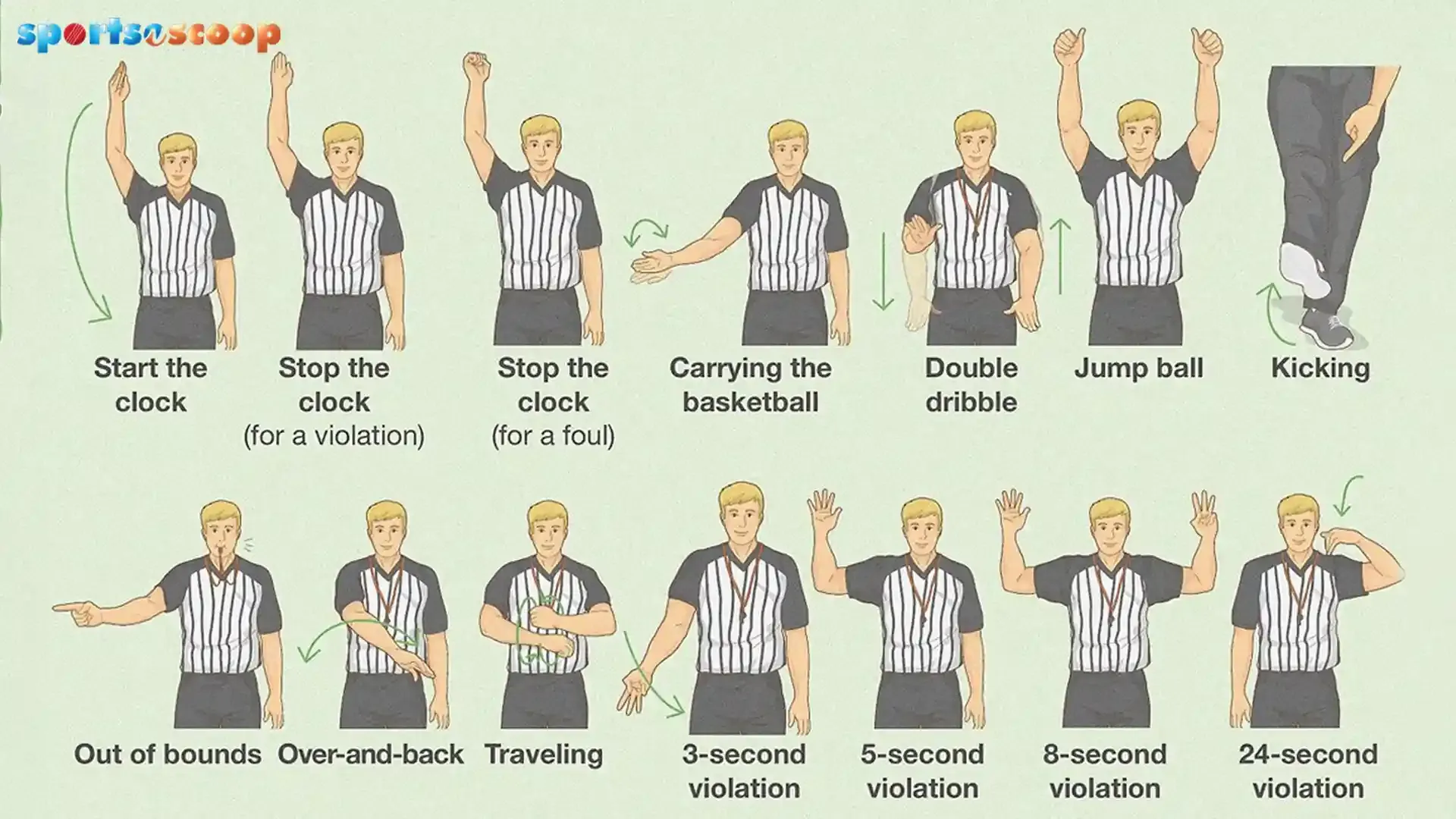
Violations stop play without a foul being charged. Here are the ones you’ll see most often when following basketball referee signals.
| Signal | How It Looks | Why It’s Made |
| Travelling | Rotating both fists in circles around each other | Player moved without dribbling; Travelling |
| Double Dribble | Patting motion with both palms | Dribbled twice or restarted a dribble |
| Carrying | Half-turn of the palm | Hand went under the ball |
| Three Seconds | Arm out, three fingers | Player stayed in the paint too long |
| Five Seconds | Five fingers shown | Ball held or inbounded too slowly |
| Shot Clock | Fingertips tapped on the shoulder | Team failed to shoot in time, i.e, 24 seconds |
| Backcourt | Arm swung across the body | The offensive side took the ball back to their court mid- play |
| Out Of Bounds | Arm pointing to the direction of play | Shows which team gets the ball |
| Timeout | Palm flat on top of fingers (T shape) | Play is paused |
Foul Signals and What They Mean
Fouls come with their own set of gestures. Basketball officials’ hand signals for fouls usually have two parts: first, the referee shows the type of contact, then points toward the free-throw direction.
| Signal | How It Looks | Why It’s Made |
| Blocking | Hands on hips | Defender wasn’t set in position |
| Charging | Fist pushed into the open palm | Offensive player ran into a set defender |
| Holding | Grabbing own wrist | Illegal grip on an opponent |
| Pushing | Both arms pushing forward | Illegal shove |
| Illegal Hand Use | Striking own wrist | Hand contact on the ball handler |
| Technical Foul | Hands forming a T | Unsporting conduct |
| Flagrant Foul | Fist raised, waved overhead | Excessive or dangerous contact |
Scoring and Free-Throw Signals
Basketball officials use hand signals to communicate the number of points scored to the scorer’s table. 1 finger means one point, 2 fingers means two, and both arms raised means a three-pointer. For free throws, the referee holds up 1, 2 or 3 fingers so everyone knows how many shots are coming.
A Fun Fact Most People Don’t Know
Referees don’t just wave their arms at random. They are trained to report a foul in a fixed order: stop the clock, show the fist, give the player’s number and then the foul type. The routine is rehearsed so well that top officials can do it in a couple of seconds, even in a loud arena. The next time you watch a game, notice how the referee holds the pause before pointing. That moment is where good officials earn their money, no pun intended. Looking for more surprises like this? Check out these amazing basketball facts you didn’t know.
Final Whistle: Watch Games Differently
Now you know the key basketball referee signals, from travelling to technical fouls. Next game, try to call the violation before the commentators do. It’s a small habit, but it makes every game more fun, and you might even end up as the person your friends ask about every call.