 By
By Most paddle purchases go wrong for one key reason: instead of focusing on their game, people default to what’s in the bag of a top pro. Which is all well and good if you’ve got the same skill level, swing, and specific hole in your game you’re looking to address. Nail those down first, and suddenly, the spec sheet isn’t so overwhelming.
Ironically, the brilliant boom in pickleball’s popularity has made the decision even tougher. Participation was up 85.7% from 2021 to 2022, making it the fastest-growing sport in America for the second straight year (SFIA). More players equals more paddle manufacturers, more marketing mumbo jumbo, and more people buying gear that doesn’t align with their style of play.
Build your shortlist and compare on paper
Understanding core, face, weight, grip, and shape helps simplify the buying process. Start by establishing a budget and shortlisting three to five paddles that fit your game and your specs. Use a pickleball paddle comparison tool where you can compare paddles based on prices, weight, core, and face material to see the difference side-by-side and find the best one that fits your criteria.
If you can, demo the paddles in question. Several local clubs, as well as online stores, now offer rental or demo programs for trying paddles before purchasing. This will provide you with a better sense of how a paddle feels for your swing. Specs indicate the performance of a paddle. A demo session confirms if it meets your expectations. To help you shortlist your paddle, consider the below factors.
Start with the power-versus-control tradeoff
Each paddle falls somewhere on the power-control continuum. In general, power paddles allow you to hit the ball harder with less effort, whereas you must provide more of your own power to achieve the same result with a control paddle. However, the trade-off is that the power paddle is less forgiving and may sometimes behave unpredictably off-center. On the other hand, a control paddle is often more forgiving of off-center hits and provides more stable ball placement in your opponent’s court.
If you’re new to the sport, favor control. It’s not close. A big sweet spot and a forgiving face will save you more points than raw pop ever will, because most beginner errors come from mis-hits and mistimed shots, not lack of power. Players who already drive the ball hard and want to add pace can start leaning toward power-oriented builds. Everyone else should default to control until their consistency catches up to their ambition.
Core material decides how the paddle feels
The core of a paddle contributes the most to how it performs. There are three main types of cores, and each influences your game in a slightly different way.
Polypropylene (polymer) honeycomb cores are pretty much the default. They give you a good mix of power and control, mute the most sound, and work well for players at just about any level. If you have no idea what you’d prefer, this is a good place to start.
Nomex honeycomb cores are stiffer and louder, and have more pop when the ball hits them. They’re popular among players who like to play hard and take advantage of extra power, but aren’t as forgiving when you’re getting started or having an off day.
Aluminum cores are rare compared to the other two. They’re the most durable and are the most consistent performance-wise over the years, but also the least touch-friendly. You may want to consider them if you’re particularly hard on paddles and you play often.
Face material is your spin and touch lever
Core sets the baseline feel. Face material fine-tunes spin and pop on top of it.
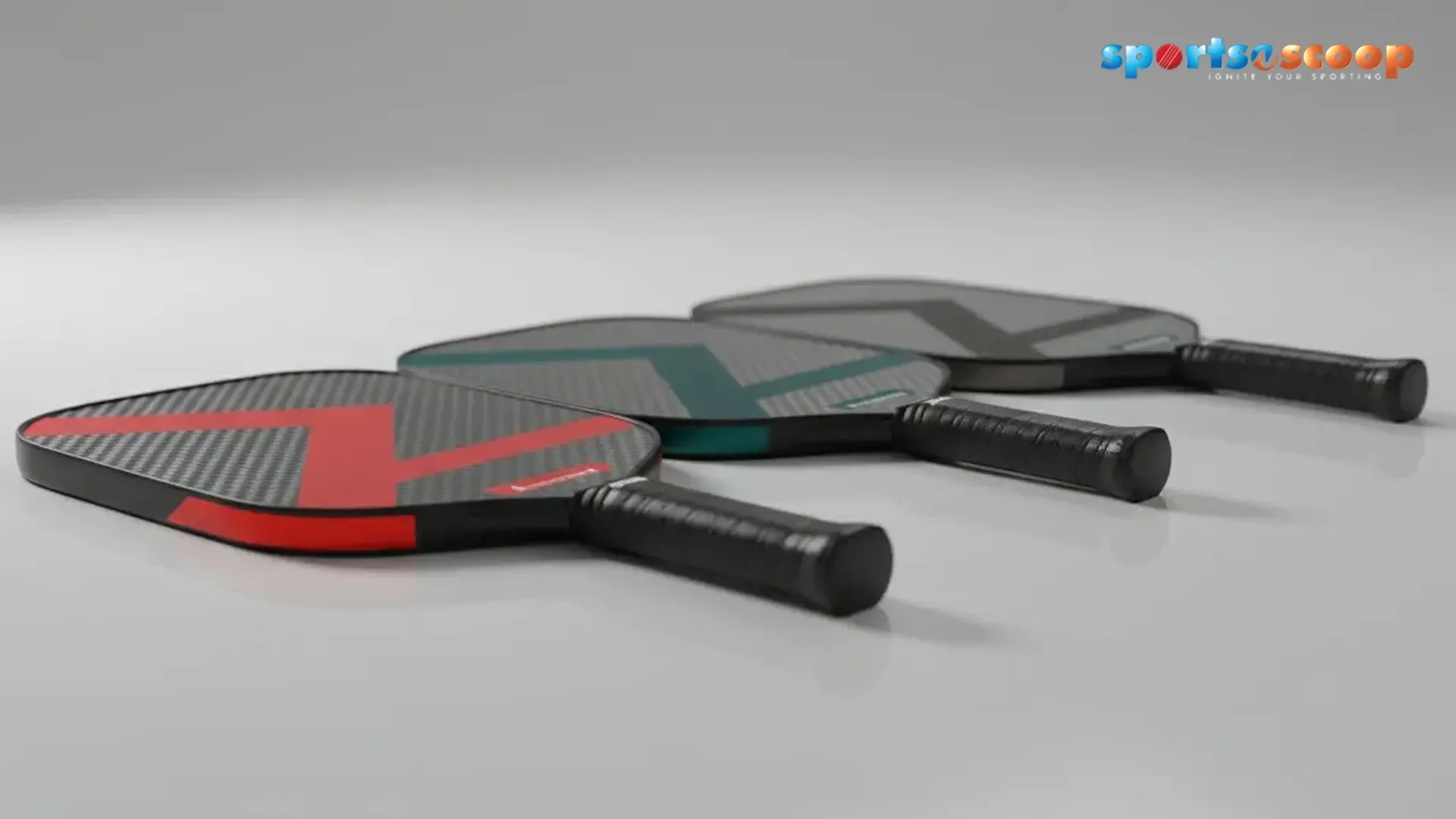
Fiberglass faces deliver the most power for the price, which makes them common in budget and mid-range paddles. Carbon fiber and graphite faces trade some of that pop for better control and touch, which is why you’ll see them on paddles marketed toward intermediate and advanced players. Raw carbon fiber weaves, left untreated rather than painted over, tend to maximize spin because the exposed weave grabs the ball more aggressively.
This is also where thermoforming comes in. It’s a heat-sealing process that fuses the face and core into one stiffer unit instead of gluing layers together. Thermoformed paddles generally feel more powerful and more solid on contact. It’s a real manufacturing difference, not just a marketing term, but it’s not magic either. A well-built glued paddle with the right specs for your game will outperform a thermoformed paddle that’s wrong for your skill level.
Face texture matters too. Rougher, grittier surfaces generate more spin, which is why some manufacturers push texture as hard as they push core material. Equipment guidelines put limits on how aggressive that texture can get, so there’s a ceiling on how much spin any legal paddle can generate. Don’t expect a texture upgrade alone to transform your spin game.
Weight and swing weight aren’t the same thing
Paddles are often categorized based on weight, as in light, medium, and heavy. Light paddles (under 7.3 oz) are easy to handle, particularly for quick volleys at the net, and less tiring for your arm over long games or practice sessions. Heavy paddles (7.8 oz and up) push the ball well but can be exhausting on your wrist and shoulder during long matches. They’re also good for windy conditions. The medium paddles (7.3 to 7.8 oz) option offers users the best control and power combination. This weight range is the best starting point for most beginners and intermediates as they get used to the trade-off between power and control.
Here’s the part most buyers miss: static weight on the box doesn’t tell you how the paddle actually feels in your hand. Swing weight – the measured resistance you feel during the swing itself – is a better predictor of feel than the number printed on the spec sheet. Two paddles can weigh the same on a scale and feel completely different once you swing them, because their weight is distributed differently. A head-heavy paddle drives more power into groundstrokes. A handle-heavy or balanced paddle reacts faster at the net. If you’re a net-focused player, don’t just check total weight. Check where that weight sits.
Grip size is smaller than most players think
The circumference of the grip normally ranges from about 4 inches to 4.25 inches for women’s-sized grips, and 4.25 inches to 4.5 inches for men’s. It may seem like an insignificant detail, but if it’s off, you’re in trouble.
A grip that’s too big hampers wrist snap, which takes a bite out of your spin and finesse. A grip that’s too small causes you to have to squeeze to keep your hold, and that extra tension is a major force behind tennis elbow. Check the fit by picking up the paddle and slipping the index finger of your non-dominant hand into the space between your fingertips and your palm. It should go in with a little room to spare, not drop in and not have to push.
If your paddle’s grip is in the neighborhood but not quite spot on, an overgrip is an easy solution. Just wrapping it on adds some extra tackiness and a tiny bit of girth, and it only costs a few bucks versus a brand new paddle.
Shape changes your reach and your sweet spot
The part of the paddle that often gets overlooked is the shape, but it’s as important in determining the feel of the paddle as the core and face material.
Widebody paddles are those short and wide, meaning that you’ll have a larger sweet spot that’s more forgiving on off-center hits. A great choice for dinking-heavy, soft-game players since the wider face is easier to block returns. Elongated paddles give up some of that sweet spot in exchange for extra reach and leverage, making them great for driving the ball and covering more court from the baseline. Standard shape paddles are a good jack-of-all-trades starting point if you aren’t sure which way you lean.
Those edge guards are a factor here, too. A foam or rubber edge will not just protect your paddle from those court scrapes and mishits we talked about but also often add a small bit of width to the sweet spot. An edgeless design is going to be pretty much exactly as wide as the paddle face is long, meaning that the sweet spot gets a little smaller but you gain a little bit of extra reach for those balls you just can’t seem to get to.
Don’t get fooled by marketing
Every new season sees the arrival of countless “pro-level” paddles that supposedly offer tournament performance. Annoyingly enough, however, the vast majority of top-level players compete with super heavily customized, weighted paddles that don’t resemble in the slightest what you can pick up in stores. Thus, if you’re hoping that buying the paddle a pro endorses is going to score you their actual setup, you’re mistaken. A $200 paddle will not fix a bad dink. It won’t fix poor footwork either. A stable, well-matched mid-range paddle almost always outperforms a flashy expensive one in the hands of someone still building fundamentals.
If you play in any sanctioned league or tournament, check the paddle against your governing body’s approved list before you buy. USAPA maintains one. And they care because certain paddle face materials and textures have been flagged for excessive spin or surface roughness. Show up with an unapproved paddle and the tournament director will unfortunately disqualify you on the spot, which is a rough way to learn that your brand new $250 paddle doesn’t actually work for sanctioned play.
Trust independent testing over spec sheets
Manufacturer specifications are not uniform and not easily read across the board. What one company considers a “control” rating is not necessarily the same as another, and there’s no universal benchmark underpinning the descriptive phrasing. Those testers not affiliated with a brand, who will release real spin rate in RPMs, stiffness readings, and even pinpoint balance measurements will provide you with the best comparison. If a paddle’s website listing gives you nothing but general descriptions, it’s best to read more before taking it at face value.
The bottom line
Shopping for a pickleball paddle isn’t about finding the magic “best” paddle that works better than every other paddle on the market. It’s about finding the perfect paddle based on your skill level and play style, and what you’re trying to improve upon next. Get the core, face, weight, grip, and shape that best suits you and your playstyle, then try out as many paddles as you can that hit all of those marks. This process gives you a far better paddle than any “Best Paddles of 2020” list ever could.