 By
When it comes to testing the mettle of a man or a woman, you can’t get more brutal and primal than boxing. Two dudes duking it out till both of them run out of time, or until one of them is knocked out or the final bell rings. Yeah, sure, a few rules too. That brings us to a rule that is often not understood by newer or sometimes even older fans: boxing weight classes. The thing is, weight matters a lot in combat sports, and just like every other combat sport, boxing has some weight classes too. Okay, it has a lot of damn weight classes. And it gets even crazier once you get to know that amateur and professional weight classes are different, and so are male and female. Let’s just cut to the chase and get started, shall we?
What Do Boxing Weight Classes Mean?
Let’s keep it simple. At its core, weight classes are divisions or categories fighters compete in. They don’t mean what you weigh, per se. Suppose you weigh 69 kg, or 154 pounds. That doesn’t mean you will compete in that weight class. In general, a boxer weighing 154 pounds usually fights between 130 and 147. They cut weight by shedding extra fat throughout the camp and water weight a week before the fight. This takes the weight to 135 or 145, whatever the fighter is comfortable with.
Major Boxing Weight Classes in All Facets of the Game
To keep it as simple as possible, listing by competition and gender seems like the best approach.
Men’s Professional Boxing Weight Classes
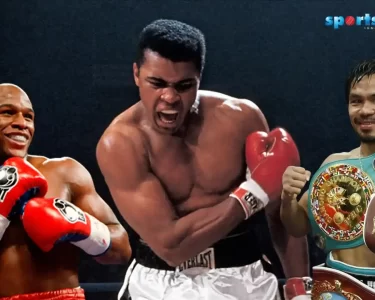
Below is a list of all the weight classes in professional men’s boxing. The list also includes some of the best male boxers in the world has ever seen, like Muhammad Ali and Floyd Mayweather.
| Weight Class | Weight(Pounds & Kg) | Greatest Champion |
| Strawweight | 105 lbs or 47.63 Kg | Ricardo Lopez |
| Light flyweight | 108 lbs or 48.99 Kg | Michael Carbajal |
| Flyweight | 112 lbs or 50.80 Kg | Jimmy Wilde |
| Super flyweight | 115 lbs or 52.16 Kg | Román González |
| Bantamweight | 118 lbs or 53.52 Kg | Éder Jofre |
| Super bantamweight | 122 lbs or 55.34 Kg | Naoya Inoue |
| Featherweight | 126 lbs or 57.15 Kg | Willie Pep |
| Super featherweight | 130 lbs or 58.97 Kg | Floyd Mayweather Jr. |
| Lightweight | 135 lbs or 61.24 Kg | Roberto Durán |
| Super lightweight | 140 lbs or 63.50 Kg | Aaron Pryor |
| Welterweight | 147 lbs or 66.68 Kg | Sugar Ray Robinson |
| Super welterweight | 154 lbs or 69.85 Kg | Thomas Hearns |
| Middleweight | 160 lbs or 72.57 Kg | Marvin Hagler |
| Super Middleweight | 168 lbs or 76.20 Kg | Andre Ward |
| Light Heavyweight | 175 lbs or 79.38 Kg | Roy Jones Jr. |
| Cruiserweight | 200 lbs or 90.72 Kg | Evander Holyfield |
| Bridgerweight | 224 lbs(WBC) or 101.60 Kg | Oscar Rivas |
| Heavyweight | >200 or 225 lbs or 120 Kg | Muhammad Ali |
* The Bridgerweight is only recognised by WBC, as of October 2026.
Women’s Professional Boxing Weight Classes
Now that we’ve covered professional men’s boxing weight classes, it’s time to look at how women’s boxing weight classes are structured.
| Weight Class | Weight(Pounds & Kg) | Greatest Champion |
| Light minimumweight /Atomweight | 102 or 46.27 | Momo Koseki |
| Minimumweight/Strawweight | 105 lbs or 47.63 Kg | Yokasta Valle |
| Junior flyweight | 108 lbs or 48.99 Kg | Yukari Ishikawa |
| Flyweight | 112 lbs or 50.80 Kg | Gabriela Fundora |
| Junior Bantamweight | 115 lbs or 52.16 Kg | Ava Knight |
| Bantamweight | 118 lbs or 53.52 Kg | Dina Thorslund |
| Junior Featherweight | 122 lbs or 55.34 Kg | Jackie Nava |
| Featherweight | 126 lbs or 57.15 Kg | Amanda Serrano |
| Junior Lightweight | 130 lbs or 58.97 Kg | Alycia Baumgardner |
| Lightweight | 135 lbs or 61.24 Kg | Katie Taylor |
| Junior Welterweight | 140 lbs or 63.50 Kg | Katie Taylor |
| Welterweight | 147 lbs or 66.68 Kg | Cecilia Brækhus |
| Junior Middleweight | 154 lbs or 69.85 Kg | Christy Martin |
| Middleweight | 160 lbs or 72.57 Kg | Claressa Shields |
| Super Middleweight | 168 lbs or 76.20 Kg | Laila Ali |
| Light Heavyweight | 175 lbs or 79.38 Kg | Claressa Shields |
| Heavyweight | >175 lbs or 79.38 Kg | Claressa Shields |
Amateur Boxing Weight Classes(Men and Women Combined)
Ok. So we are finally clear of the professional weight classes in boxing. But what about the amateur ones? Because the landscape looks a lot different there. Moreover, amateur boxing weight classes often vary by event. So for this list, we will only include the amateur boxing weight classes in the Olympics, the LA Olympics 2028, to be precise. So what are the weight classes in the LA28 Olympics? This time, the IOC has shortlisted 7 weight classes for men and women. They are as follows:
| Gender | Weight Classes | Greatest Ever | Gold Tally |
| Male | 55 Kg | Guillermo Rigondeaux 🇨🇺 | 2 |
| Male | 60 Kg | Mario Kindelán 🇨🇺 | 2 |
| Male | 65 Kg | Roniel Iglesias 🇨🇺 | 2 |
| Male | 70 Kg | Jerzy Kulej 🇵🇱 | 2 |
| Male | 80 Kg | Félix Savón 🇨🇺 | 3 |
| Male | 90 Kg | László Papp 🇭🇺 | 3 |
| Male | Over 90 Kg | Teófilo Stevenson 🇨🇺 | 3 |
| Female | 51 Kg | Nicola Adams 🇬🇧 | 2 |
| Female | 54 Kg | Claressa Shields 🇺🇸 | 2 |
| Female | 57 Kg | Kellie Harrington 🇮🇪 | 2 |
| Female | 60 Kg | Katie Taylor 🇮🇪 | 1 |
| Female | 65 Kg | Claressa Shields 🇺🇸 | 2 |
| Female | 70 Kg | Claressa Shields 🇺🇸 | 2 |
| Female | 75 Kg | Claressa Shields 🇺🇸 | 2 |
Why Do These Boxing Weight Classes Even Matter?
We now know what all the weight classes are in boxing. However, anything without meaning is of no use whatsoever. So that brings us to the reason why weight classes exist in the first place. Boxing, or all combat sports, are, at least in theory or in purists’ minds, the most apt simulation of a real-life, on-the-fly altercation. So it does make sense to just remove the weight classes. But simply simulating a real fight environment is not what those sports are about. They are, inherently and by definition, sports. As a result, a set of rules is needed to formalise them. On top of that, it is entertainment, and tickets only sell when there is bad blood or the element of surprise- who knows what might happen. A 100 kg man fighting a 60 kg guy wouldn’t end in a surprise 9 out of 10 times.